Reflections on the consolations of running in nature during the Covid-19 pandemic
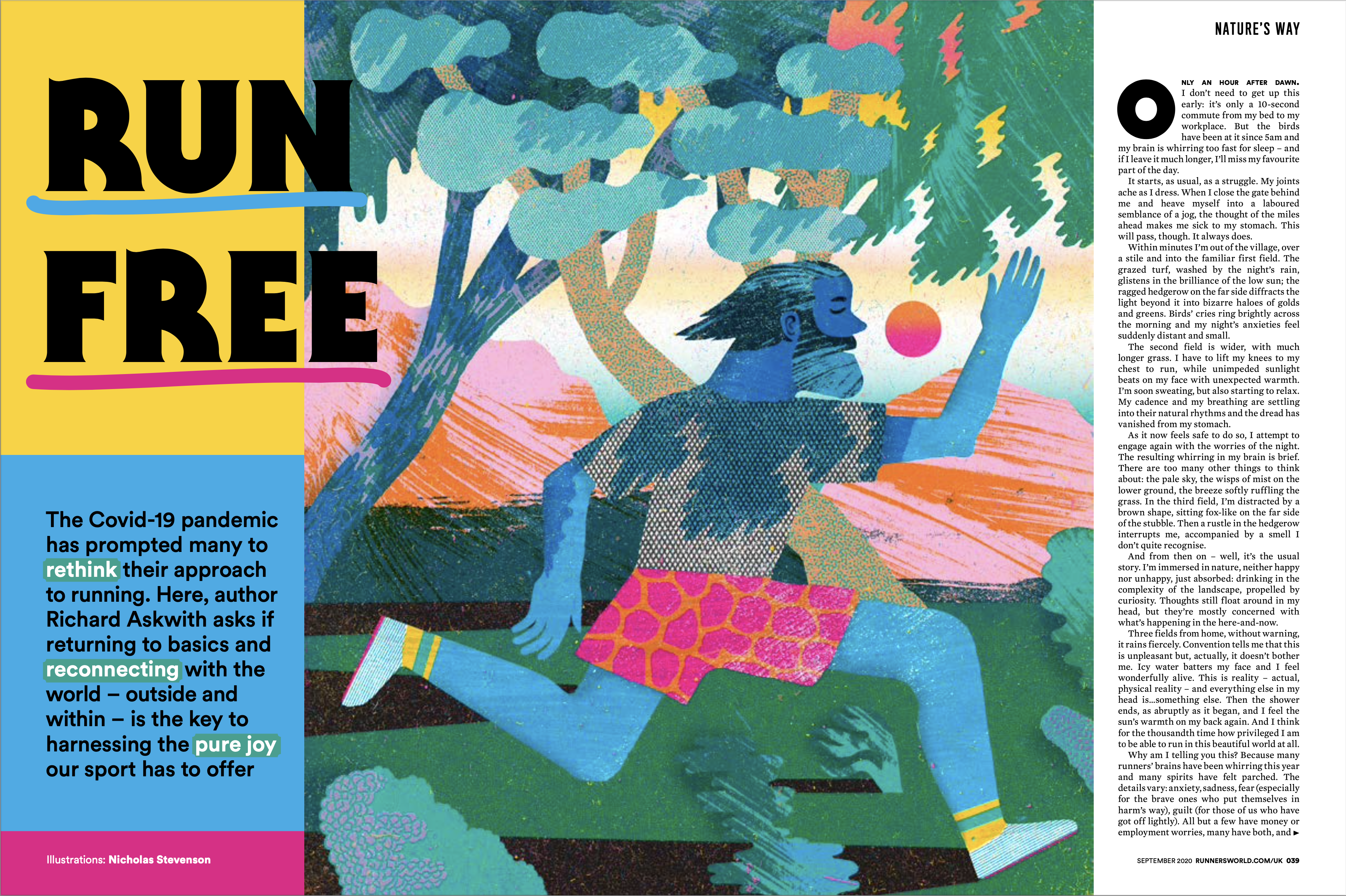
‘Runner’s World’ (UK), September 2020
ONLY an hour after dawn. I don’t need to get up this early: it’s only a 10-second commute from my bed to my workplace. But the birds have been at it since 5am and my brain is whirring too fast for sleep – and if I leave it much longer, I’ll miss my favourite part of the day.
It starts, as usual, as a struggle. My joints ache as I dress. When I close the gate behind me and heave myself into a laboured semblance of a jog, the thought of the miles ahead makes me sick to my stomach. This will pass, though. It always does.
Within minutes I’m out of the village, over a stile and into the familiar first field. The grazed turf, washed by the night’s rain, glistens in the brilliance of the low sun; the ragged hedgerow on the far side diffracts the light beyond it into bizarre haloes of golds and greens. Birds’ cries ring brightly across the morning, and my night’s anxieties feel suddenly distant and small.
The second field is wider, with much longer grass. I have to lift my knees to my chest to run, while unimpeded sunlight beats on my face with unexpected warmth. I’m soon sweating, but also starting to relax. My cadence and my breathing are settling into their natural rhythms and the dread has vanished from my stomach.
As it now feels safe to do so, I attempt to engage again with the worries of the night. The resulting whirring in my brain is brief. There are too many other things to think about: the pale sky, the wisps of mist on the lower ground, the breeze softly ruffling the grass. In the third field, I’m distracted by a brown shape, sitting fox-like on the far side of the stubble. Then a rustle in the hedgerow interrupts me, accompanied by a smell I don’t quite recognise.
And from then on – well, it’s the usual story. I’m immersed in nature, neither happy nor unhappy, just absorbed: drinking in the complexity of the landscape, propelled by curiosity. Thoughts still float around in my head, but they’re mostly concerned with what’s happening in the here-and-now.
Three fields from home, without warning, it rains fiercely. Convention tells me that this is unpleasant but, actually, it doesn’t bother me. Icy water batters my face and I feel wonderfully alive. This is reality – actual, physical reality – and everything else in my head is…something else. Then the shower ends, as abruptly as it began, and I feel the sun’s warmth on my back again. And I think for the thousandth time how privileged I am to be able to run in this beautiful world at all.
Why am I telling you this? Because many runners’ brains have been whirring this year and many spirits have felt parched. The details vary: anxiety, sadness, fear (especially for the brave ones who put themselves in harm’s way), guilt (for those of us who have got off lightly). All but a few have money or employment worries, many have both, and some face hunger and despair. The underlying cause has been the same; and so, for most runners, has the additional complication: with the suspension of races and group training, our access to our safety-valve has been drastically altered.
I’m one of the guiltiest, luckiest ones. I live in a small rural village and, except on special occasions, I run alone. I’m more interested in interacting with nature than in shaving seconds off my personal bests, so coronavirus has made little difference to my running habits. But that’s a rare privilege. If you’re part of the large majority whose lives as runners involve clubs, tracks, races, championships, parkruns, training groups and big city marathons, then this has been, at best, a challenging year. And if you started 2020 with any kind of competitive target or plan – well, you have my sympathy.
Yet runners respond well to challenges. So this has also been a year for thinking about ways of running that remain viable and rewarding even in a socially distanced world. And that’s where my running habits come into it. They may not be to everybody’s taste, but it’s hard to imagine a time more suited to running in a solitary, contemplative, low-tech and nature-focused way. And it’s not just me who’s saying that.
I’ve written three books about running. The first, Feet in the Clouds (about fell- running) and the third, Today We Die a Little (about Emil Zátopek), went down reasonably well with the running community, probably because they told the stories of runners far more talented and interesting than me. My second, Running Free, was more controversial. Published in 2014, it was a personal memoir of my ‘runner’s journey back to nature’. Much of it described my evolution from relatively normal competitive runner – driven, results-focused, well equipped and obsessed with marginal gains – to watch-less rural eccentric. It also sketched an alternative philosophy of running, based on mindfulness, nature and spiritual refreshment. Much of the book consisted of detailed descriptions of my everyday rural running experiences, into which I wove explorations of two related ideas. The first was that, if we were to strip away all the modern trappings that have become embedded in our sport over the past half century – the £200 shoes, the high-tech clothes, the £500 GPS watches, the sports drinks and nutritional supplements, the £50-entry events, the £200 headphones and the digital tracking, sharing and comparative measurement of every exploit – we would still be left with a wonderful and rewarding sport. The other idea was that all that stripping-away might free the undistracted mind to apprehend more richly the sensations of the moment; and that this in turn might make running a more joyful and rewarding experience.
Perhaps I expressed myself badly. Perhaps my message simply wasn’t relevant to many runners. At any rate, the book’s reception was – as the traditional euphemism has it – ‘mixed’.
Many readers were enthusiastic; some said the book had changed their lives. A sizeable minority took a different view. That is to say: they were enthusiastic, but not in a good way. I was accused of hypocrisy, snobbery, elitism; above all, of a lack of respect for those who preferred different approaches to running. I found this sad and unfair; I hadn’t meant to upset anybody, just to suggest an alternative way of looking at things. Perhaps I could have been gentler in my questioning of the commercial forces I caricatured as ‘Big Running’. And perhaps I should have repeated even more emphatically than I did that I wasn’t claiming my approach to running was superior to more popular approaches. (I did repeat it pretty often, though.) In any case, the point of the book wasn’t to criticise but to celebrate and share something positive: a way of running I felt incredibly lucky to have found and that I hoped might also enrich other lives.
But brutal feedback is something you sign up for when you become an author, and some book-buyers enjoy giving it. After a while, for the sake of my mental health, I stopped reading the reviews, good or bad. I’d felt proud if it, but the publication of Running Free became a slightly sad episode in my memory, to be dwelt on as little as possible.
Yet the book itself has remained very close to my heart. In fact, out of everything that I’ve written in 40 years as an author and journalist, it’s the only text of mine to which I regularly return, dipping into it not for self-criticism or self-congratulation but to remind myself how to be sane. It’s not the writing that draws me back: it’s the record of my lived experiences of running and the reminder of nature’s extraordinary power to boost a runner’s mental wellbeing.
I’ve dipped into it several times this year. And I haven’t been alone. Ever since the Covid-19 hit the fan, readers have been getting in touch with me about Running Free in surprising numbers; and this time they’ve been enthusiastic in a good way. It seems they have been using the book in much the same way as I have. They’re drawn by the ideas at its core and by the thought that, in this new age of anxiety and isolation, there are worse things a runner could do to boost their wellbeing than convert their daily training for a few months into a form of meditative interaction with nature.
The link between nature and wellbeing is well established. We evolved as rural creatures, and the human psyche thrives amid greenery. Research has shown that just seeing the colour green can be calming and relaxing, and a walk or run in the park dissipates stress more effectively than the same activity on hard pavements. Looking at fractals – those limitlessly elaborate shapes that underlie everything we see in nature – also affects the brain in mood-enhancing ways. When it rains, the smell that rises from the soil afterwards (it’s called petrichor) activates areas of the brain associated with calmness. Walking among trees and inhaling their aromas (phytoncides) boosts the immune system and improves mental health.
That much is uncontroversial. Running Free explores a more complex chain of links: not just between wellbeing and nature but between wellbeing, nature and running – and between all three and a certain kind of mindfulness. This shouldn’t have been controversial, either. The benefits of running are well known; nor is there much doubt about the contribution mindfulness can make to mental health – although different people mean different things by that word. Some would say that running mindfully means blanking out all external distractions to focus solely on the physical experience of running. For me, it’s mindful enough just to focus on the moment you’re in, including your environment, rather than on the outcome you’re hoping to achieve.
What prompted Running Free was the realisation that combining all three therapies – running, nature and attentiveness to the lived moment – multiplies their potency spectacularly. I’ve always had a gloomy streak; a tendency, in my bleakest moments, to perceive my comfortable life as grey, limited and oppressively predictable, and myself as too hopeless and helpless to change things. And there have been times, in my greyest periods in the past, when running has felt like a chore: just one more item to be dealt with on the daily conveyor belt of drudgery. These days, however, I experience each run as a treat: a unique interaction between me and the constantly changing Northamptonshire landscape. All I have to do is focus on the lived experience of the run rather than on short-term or long-term objectives, and I can be pretty sure that, no matter how grey life seemed when I started out, I will finish feeling alert, strong and grateful to be alive. It’s not just the endorphins. It’s the nature, the irrepressible, luxuriant life of the landscape, soothing and refreshing me as I run through it. The sights, sounds and smells absorb me. Wildlife distracts me. Fresh air fuels me. The texture of the earth beneath my feet makes me feel grounded and reconnected to the land. And by forgetting myself – my targets, my worries, my duties – I allow my being to recharge and reset itself. Or rather: I leave myself open for nature to recharge me.
Obviously, it helps if you live, as I do, within easy reach of some countryside. But you don’t have to. Many of those lockdown messages mentioned earlier came from readers who live and run in towns and cities. People have contacted me recently from London, New York, Edinburgh, Leeds and Portsmouth to share their thoughts about running mindfully in nature. Several have made the point that such running is as much a matter of attitude as of geographical location. Few of us live in genuine wilderness. Most of us do have access to some kind of relatively green or wild space – a park or a riverside or just a piece of wasteland. As long as it’s somewhere where nature, not humanity, calls the shots, the chances are you’ll find it refreshing. But what you find there depends partly on where your attention is, and that’s up to you.
If you’re anything like the runner I used to be, the attention you usually pay to your environment is likely to be limited – wherever you live. You’ll be too busy thinking about your pace, your split times, your targets or what your data will look like when you share it. You’ll probably be on a familiar route, too, navigating on autopilot. As for what you’re experiencing physically, screening things out is what runners do best.
You’ve been training for years not to notice pain or exhaustion – to ignore all your feelings except those you’ll feel at the finish. Much of what happens on the way passes by in a blur.
But running isn’t only about times and results; and Running Free was partly about how, in middle age, I rediscovered another side of running: the joy that comes from noticing. I had become so focused on outcome that I barely experienced the process any more. So I made a conscious effort to run in a more mindful way, focusing on what was happening in the moment rather than on what I was trying to achieve. It became a habit. It felt good. And because I live in the countryside, the more I ran like this, the more the restorative powers of nature came flooding into my life.
At around the same time, i resolved to end my addiction to running products. I’d been a kit junkie for decades, but I was now beginning to notice that the more I embraced my new ‘natural’ running habits, the less I cared about all those items of cutting-edge running equipment that I had once found so essential. I realised I didn’t need ‘moonshot’ products; I just needed to have my mind in the right place. So back-to-nature also became back-to-basics; and, over time, I realised this was another liberation. I had ceased to see running with a consumer’s mindset, in which you spend money to achieve a desired outcome. As a result, I remembered how to appreciate running as one of life’s great free gifts, like friendship, sex or laughter.
This final stage in my psychological journey was an afterthought, yet in recent months it has come to feel more important than ever. The marketing messages of the running industry constantly reinforce the idea that you’ll never achieve your goals if you don’t buy products X, Y and Z. But what if the economy turns overnight to ashes and you can’t imagine being able to afford that kind of expenditure ever again? Should you give up running – or abandon your running dreams? Or could you still be a runner – a good, fast, fulfilled runner – without ever spending another penny on high-performance kit?
We have grown used to thinking that our comfortable consumer society will last for ever: that there will always be growth, jobs and as many leisure options as we’re willing to pay for. But what if it’s all more fragile than that? To me it feels both reassuring and empowering to know that – with a social and economic wasteland stretching ahead of us – I can find fulfilment from the simple pastime of putting one foot in front of the other.
When I wrote Running Free, I probably overestimated the number of runners who shared my need for spiritual and emotional refreshment. Yet in this year of lockdown, even habitual optimists have been feeling fragile. Lives that once buzzed with social stimulation have become constrained and predictable, starved of human warmth or darkened by foreboding. Most conventional forms of running have been made unfeasible by social distancing; and although, as I write this, the worst of the lockdown appears to be over, that may not last. Meanwhile, few of us feel as relaxed as we used to about throwing money at our running habit.
Could a back-to-basics, back-to-nature running philosophy help? Most runners will be sceptical. Yet for many of us, at the time of writing, there aren’t many other options, running-wise – unless you live in New Zealand or the Isle of Man. Running mindfully in the moment, drinking in your surroundings, nature-watching, at no special expense, may be one of the best kinds of running available to you.
When I simplified my own running habits, the one running aid I didn’t dispense with was a dog, and I have learnt, over time, to run with something approaching canine curiosity. Like a dog, I’m constantly asking myself questions: What’s that smell? What’s that sound? What’s that shape scurrying through the undergrowth? I think of this as rural running, but, of course, there are similar questions to be asked in every town and city. Where are those people going? Why is that man dressed like that? When was that building put up?
But running curiously isn’t just about looking outwards. It’s also about focusing eagerly on the internal experience of running. Never mind your pace; never mind your targets; never mind the biometric data you’re recording for later. What do you feel now? What are your limbs doing, right now, in this unique moment? What can you feel with your feet? How do your movements relate to your breathing – or to the ground underfoot? What would it feel like if you tried to sprint up that hill with the smoothest possible rhythm?
Studies suggest this kind of mindful running can, if you practise it, improve performance, but that, to me, is beside the point. The most valuable thing we get from running is wellbeing; and that has rarely been more precious – or elusive – than it is today.
By the time you read this, things may have changed dramatically for the better, and some of our best-loved sources of running-related fulfilment – involving crowds, clubs, cities and competitions – will have been restored to us. I sincerely hope so – even if that means an end to the current ripple of interest in Running Free. But if we’re still grimly distancing, don’t forget that there’s almost always a way of brightening your life just by going out and running, simply and attentively, in nature. It’s available to everyone. And it’s free.
First published in Runner’s World UK (https://www.runnersworld.com/uk/ )
 richardaskwith.com